

Shop by Brand
Ocracoke 20
Builders Logs Hull #1 Construction Album Performance Numbers Materials List
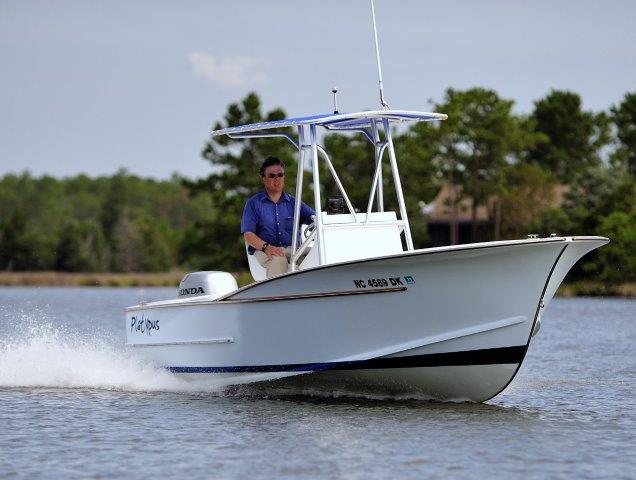
The boat is very fast, yet amazingly economical. She has been clocked by GPS at 42mph (36.5 knots) with five adults on board, with only a 90 HP outboard. Most boats of this size require a 150 HP package. As a matter of fact engine dealers, used to heavier FRP boats with deeper V sections, tried to dissuade us from using only a 90 HP, claiming it would be a “waste to have such a nice boat underpowered”.
Specs:
LOA………20′-0″ [6.1] m
LWL………16′-4” [4.98] m
BEAM………7′-8” [2.34] m
DRAFT/ hull………9″ [23] cm @ DWL
*DISPLACEMENT………2000 lbs (907 kg) @ DWL
Bare hull weight ~1350lbs (612 kg)
Dry Weight including 90 hp motor…~1800lbs (816 kg) depending on materials and options*
Pounds Per I” immersion 372# (169kilos)
Deadrise at transom… 13 degrees
Horsepower…… 70 – 150 (max)
*weight @ designer’s suggested materials; different plywoods and/or different fiberglass weight and optional gear will change boat weight.
About the Ocracoke 20
Like her bigger sisters (Ocracoke 24 and the Ocracoke 256) The boat is cold molded plywood, built over a jig/framing. Most of the “jig” becomes permanent structure. The construction employs a modified egg crate method that is both light and strong. This boat is aimed at efficiency of materials for performance. She is not a stitch and glue “introduction to building” type of boat. If you are familiar with working with wood, epoxy, and fiberglass then the full size templates and plans will present no problems for the patient builder. Want a jump start on the build? We can supply CNC cut kits for the framing components.
As can be seen below, the first, third and fifth frames are temporary. All of the rest of the structure stays in the boat. The forward sheer clamp and the stringers have been installed to complete the hull framing.
The bottom of the hull is planked with a single layer of 1/2″ (12mm) plywood in the aft sections and 2 layers of 1/4″ (6mm) ply with staggered seams in the forward section. The sides are planked with two layers of 3/16″ (4mm) ply using the Ashcroft method which means both layers run diagonally in the same direction, the seams in the two layers are staggered (see below).
The entire boat is epoxy and fiberglassed inside and out with one layer of 1208 biaxial fiberglass glass cloth which makes for a very strong tough structure. The complete encapsulation of the wood creates a very low maintenance and a long-lived boat. The boat is painted with epoxy primer and the top coat is two part polyurethane paint.

 Construction Plan:
 All plan sheets for construction plus full size mylar templates. There is no table of offsets because the full size templates make them redundant. Mylar templates shown below in “warped view”. Trace the parts directly onto your plywood and cut out with a jig saw. Included are: Stem and keel; temporary frames, permanent frames/doublers; bulkheads; transom and transom arc; bottom stringers. The frames and bulkheads and drawn with the notches located and sized for the side stringers. Each of the parts is color coded: Examples: bottom stringers – blue; temporary frames-green. The drawings are 1/2 of each frame, transom etc.. When tracing your parts on the wood you will simply flip the patterns. The use of the template patterns eliminates any need for lofting and ensures that your framework will be accurate and true.
*Mylar is drafting film, which while it is quite expensive, is totally stable and practically tear proof. It is practically transparent, making it easy to orient on your plywood grain and allows for it to be used for both sides on one sheet
Jig Kit:
Kit parts include: CNC cut southern yellow pine keel/stem timbers ready for scarfing and laminating. CNC cut plywood, frames, bottom stringers, and transom layers. Also included are the temporary frames and transom jig CNC cut from 3/4″ birch plywood. The jig kit does NOT include the dimensional lumber needed for the frame or “strong back” onto which the frames are secured.
Kit parts include: CNC cut southern yellow pine keel/stem timbers ready for scarfing and laminating. CNC cut plywood, frames, bottom stringers, and transom layers. Also included are the temporary frames and transom jig CNC cut from 3/4″ birch plywood. The jig kit does NOT include the dimensional lumber needed for the frame or “strong back” onto which the frames are secured.
Planking (Plywood):
NOTE: Shop Pickup Only
We are happy to supply marine plywood for anyone picking up their kit locally but we prefer not to ship marine plywood alone. There are many suppliers around the country that can supply it locally.
Plywood planking for the bottom, sides, deck and cockpit soles.
-2 sheets 1/2″ (12mm) Okume BS1088, aft bottom planking
-7 sheets 3/8″ (9mm) Okume BS1088, deck and cockpit sole
-4 sheets 1/4″ (6mm) Okume BS1088, forward bottom planking
-9 sheets 3/16″ (4mm) Okume BS1088, side planking (ashcroft method)
What else will I need?
Solid wood:
Our kit options do not include solid wood for stringers and cleats that you will need. We prefer our builders to locally source this material and rip into long lengths. It is not practical for us to ship these long pieces on a boat of this size. If you are picking up your kit from our shop we would be happy to let you select pine boards from our stock to use for your stringers.
Jig Frame:
The Jig frame is to be made of standard dimensional lumber which can be purchased at any local hardware store.
Epoxy and fiberglass supplies:
We can supply your epoxy and fiberglass needs. Just ask.